
Sub-Total: $0.00
Rodents & Nuisance Mammals Guide
Packrats / Woodrats (Neotoma spp.)
Native. Love to make nests out of cholla or anything else they can find. They are super cute, the breed fast, their nests tend to be in the ground or up to hip high but usually stay low to the ground. They tend to nest under AC units and in the air vents of cars and cause a considerable amount of damage chewing in wires.
Please do not rip apart their nests to displace them. That will only make your job harder. Please take out the species before taking out their nests.
Pack rats are very damaging and persistent but trap easily with live traps or snaps if persistent. Nests should be cleaned up so they are not easily reused by others in the area. Recommend a trapping program along SenesTech wax bait pouches.
Where they live (AZ): Desert scrub, rocky areas, and human structures (vehicles, sheds).
Lifespan: ~2–3 years
Sexual maturity: ~8 months
Gestation: ~30–36 days
Babies/litter: Babies per litter 2-4. Litters per year 2–3.
Weaning: 2–4 weeks
Problematic status: Known for chewing wires, nesting in cars/equipment, and carrying parasites.

Roof Rat (Rattus rattus)
These are the most problematic species and hardest to control. They are very smart and even though they are known to be in attics they also have no problem living in the ground too. Roof rats are the smartest of all the species and do the most damage. If you feed them bait and it makes them sick but does not kill them, they will learn to stay away from it and they will teach their family members to stay away as well.
Roof rats are known to be in urban areas where the native species of rodents have been pushed out. Roof rats are an urban pest issue due to habitat loss.
SenesTech liquid birth control works best for shutting down their reproduction while trapping them. Clean and reset traps daily if you have an issue with them. Put all food sources in containers to limit their food source. Pre-bait traps before setting for a better kill rate. These guys will eat the birth control like candy daily, but you will have to change trapping areas and techniques every month or so to keep outsmarting them.
Where they live (AZ): Urban/suburban attics, palms, citrus groves
Lifespan: ~1 year (≤3).
Sexual maturity: 3-4 months
Gestation: ~21-23 days
Babies/litter: Babies per litter 5-8. Litters per year 4-5.
Weaning: 3–4 weeks
Problematic status: Major urban and orchard pest, damages fruit, wiring, and carries disease.

Norway Rat (Rattus norvegicus)
Where they live (AZ): Cities, barns, sewers, livestock areas
Lifespan: ~1-2 years
Sexual maturity: 2-3 months
Gestation: ~21-23 days
Babies/litter: Babies per litter 6-12. Litters per year 4-7.
Weaning: 3–4 weeks
Problematic status: Major urban/agricultural pest, destructive to grain storage and feedlots.

House Mouse (Mus musculus)
Where they live (AZ): Homes, barns, food storage, fields
Lifespan: ~1 year
Sexual maturity: 6-8 weeks
Gestation: ~18-21 days
Babies/litter: Babies per litter 4-8. Litters per year - up to 8.
Weaning: ~3 weeks
Problematic status: Common household pest, contaminates food and spreads disease.

Deer Mice (Peromyscus spp.)
Where they live (AZ): Deserts, woodlands, and barns/houses
Lifespan: ~1 year (≤2)
Sexual maturity: 6-8 weeks
Gestation: ~23 days
Babies/litter: Babies per litter 3-6. Litters per year 2-4.
Weaning: ~3 weeks
Problematic status: Enter homes and outbuildings; known vector for hantavirus.

Merriam’s Kangaroo Rat (Dipodomys merriami)
Not known to do much damage outside of landscaping holes. These holes tend to be open or closed, symmetrically shaped and usually numerous in one area. Small mouse traps with one-way doors work well. Bait with seed. If populations get out of control, they can do some damage to vehicle wiring. Recommend SenesTech wax bait along with a trapping program if problematic.
Where they live (AZ): Desert flats, sandy/gravelly soils
Lifespan: ~2-3 years (wild)
Sexual maturity: 2-3 months
Gestation: ~28-32 days
Babies/litter: Babies per litter 1-6. Litters per year 1-2.
Weaning: 15-25 days
Problematic status: Ecologically beneficial seed disperser.

Desert Pocket Mouse (Chaetodipus penicillatus)
Field Mice/Pocket Mice - Many of the mice are easy to control. In most cases they get into dog doors or sometimes push up into attics when it rains. They are controlled easily through birth control and traps. They usually have a grouping of covered over holes they like to nest in but will also use small openings under rocks.
Where they live (AZ): Desert scrub, sandy soils
Lifespan: 1-2 years
Sexual maturity: 3 months
Gestation: ~23-26 days
Babies/litter: Babies per litter 1-7. Litters per year 2-3.
Weaning: ~3-4 weeks
Problematic status: Not considered a pest.

Round-tailed Ground Squirrel (Xerospermophilus tereticaudus)
Native. Love to live near houses. They do make a lot of holes around the base of plants. In a native garden setting, these rodents will help your plants grow by fertilizing the soil and helping water get into the roots. They don't want to be in your home or car, and you can get them to move pretty easily with disturbance. However, they love to eat vegetable gardens and the tops of ornamental plants. They also are known to chew into irrigation lines. Giving them water to drink discourages the line chewing. Planting native plants discourages any plant damage.
Where they live (AZ): Sonoran desert flats and washes
Lifespan: 3-4 years
Sexual maturity: ~10-11 months
Gestation: ~28-30 days
Babies/litter: Babies per litter ~5.
Weaning: ~5-6 weeks
Problematic status: Can damage gardens and irrigation but also a key prey species.

Harris’s Antelope Squirrel (Ammospermophilus harrisii)
Native. Not problematic. They will make small holes in the yard but are not known to chew wires or do damage. We do not recommend any control for antelope squirrels unless you are really having an issue. They are not known to do any damage.
Where they live (AZ): Desert scrub, rocky slopes
Lifespan: 2-4 years
Sexual maturity: ~1 year
Gestation: ~30 days
Babies/litter: Babies per litter ~5-10.
Weaning: ~6 weeks
Problematic status: May raid gardens/feed

Rock Squirrel (Otospermophilus variegatus)
Native. They tend to tear up garden beds and make large holes under cactus but do not usually cause any damage to electrical wiring. Just plants. These are easily live trapped and moved if problematic. We do not recommend killing them.
Where they live (AZ): Rocky areas, farms, orchards
Lifespan: 2-3 years
Sexual maturity: ~1 year
Gestation: ~30 days
Babies/litter: Babies per litter ~3-9. Litters per year 1-2.
Weaning: ~6 weeks
Problematic status: Agricultural pest; burrows damage irrigation, raid crops.

Arizona Cotton Rat (Sigmodon arizonae)
Where they live (AZ): Grassy/riparian cover, fields, canals
Lifespan: 1-2 years
Sexual maturity: 30-60 days
Gestation: 27-30 days
Babies/litter: Babies per litter ~3-7.
Weaning: 10-25 days
Problematic status: Can be a pest in ag fields, canals, and gardens.

Botta’s Pocket Gopher (Thomomys bottae)
Hard to control. Baits tend not to work on them but getndug up by other animals like house mice, coyotes, or domestic pets. Pocket gophers are known to do large amounts of damage to landscape plants in a short amount of time and leave multiple large, closed mounds. Never use poison on pocket gophers. Fume or manual gopher traps only.
Where they live (AZ): Burrows in fields, lawns, shrub lands
Lifespan: 2-3 years
Sexual maturity: 9-12 months
Gestation: 19 days
Babies/litter: Babies per litter 4-7. Litters per year 1 (sometimes more).
Weaning: 5-6 weeks
Problematic status: Serious pest in lawns, farms, orchards, golf courses.

Jackrabbits (Black-tailed & Antelope)*
Status: Native lagomorphs (not rodents)
Where they live (AZ): Desert scrub, grasslands, farms
Lifespan: 1-5 years
Sexual maturity: ~7 months
Gestation: 41-47 days
Babies/litter: Babies per litter 2-4. Litters per year 2-3.
Weaning: ~3 weeks
Problematic status: Can heavily damage alfalfa, orchards, and gardens.

Cottontail Rabbits (Desert & Eastern)*
Live in small shallow nests on the ground. Some people don't like them because they think they chew on drip lines and wires but really they just eat ornamentals. Live trapping only.
Status: Native lagomorphs (not rodents)
Where they live (AZ): Desert scrub, riparian, farms, and suburbs
Lifespan: 1-3 years
Sexual maturity: 2-3 months
Gestation: 25-30 days
Babies/litter: Babies per litter 2-6. Litters per year 3-5.
Weaning: ~2-3 weeks
Problematic status: Common garden and crop pest.

Arizona Non-Rodent Mammals Reference
Striped & Hooded Skunks (Mephitis mephitis, Mephitis macroura)
- Status:
- Where they live (AZ): Brushy desert, riparian corridors, agricultural edges, and even under decks/sheds.
- Lifespan: Wild ~2–3 years; up to 10–15 in captivity.
- Sexual maturity: ~1 year.
- Gestation: 59–66 days.
- Babies/litter: 4–6 (range 3–8). Litters/year:
- Weaning: 6–8 weeks; independent by 2–5 months.
- Problematic status: Considered nuisance around homes, chicken coops, golf courses, and farms; dig for grubs and may spray when disturbed.
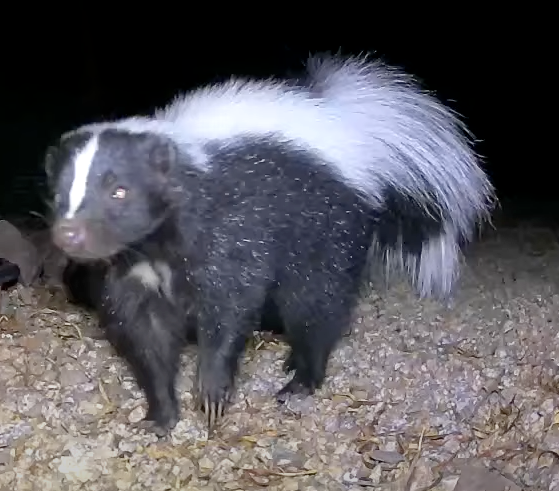
Striped Skunk
Raccoon (Procyon lotor)
- Status:
- Where they live (AZ): Riparian corridors, canals, orchards, urban parks, and agricultural zones with water.
- Lifespan: Wild 2–5 years; up to 16+ possible.
- Sexual maturity: Females ~1 yr; males ~2 yrs.
- Gestation: 63–65 days.
- Babies/litter: 2–5 (often 3–4). Litters/year:
- Weaning: 7–16 weeks; independent ~8–12 months.
- Problematic status: Nuisance in urban and farm areas—raid crops, trash, and poultry. Also can spread rabies and parasites.

Ringtail (Bassariscus astutus)
- Status: Native (AZ state mammal).
- Where they live (AZ): Rocky canyon walls, cliffs, riparian corridors, mines, outcrops.
- Lifespan: Wild ~5–7 years; up to 9+ in captivity.
- Sexual maturity: ~10–12 months.
- Gestation: 51–54 days.
- Babies/litter: 1–4 (avg 2–3). Litters/year:
- Weaning: 8–10 weeks.
- Problematic status: Mostly beneficial as predators of rodents/insects; occasionally den in attics or sheds.
White-nosed Coati (Nasua narica)
- Status: Native (restricted to SE AZ sky islands).
- Where they live (AZ): Oak-sycamore canyons, riparian woodlands, rocky highlands.
- Lifespan: Wild ~7–8 years; longer in captivity.
- Sexual maturity: Females ~2 yrs; males ~3 yrs.
- Gestation: 70–77 days.
- Babies/litter: 2–7 (often 3–4). Litters/year:
- Weaning: ~2–4 months.
- Problematic status: Locally rare and valued for ecotourism; not considered a pest.